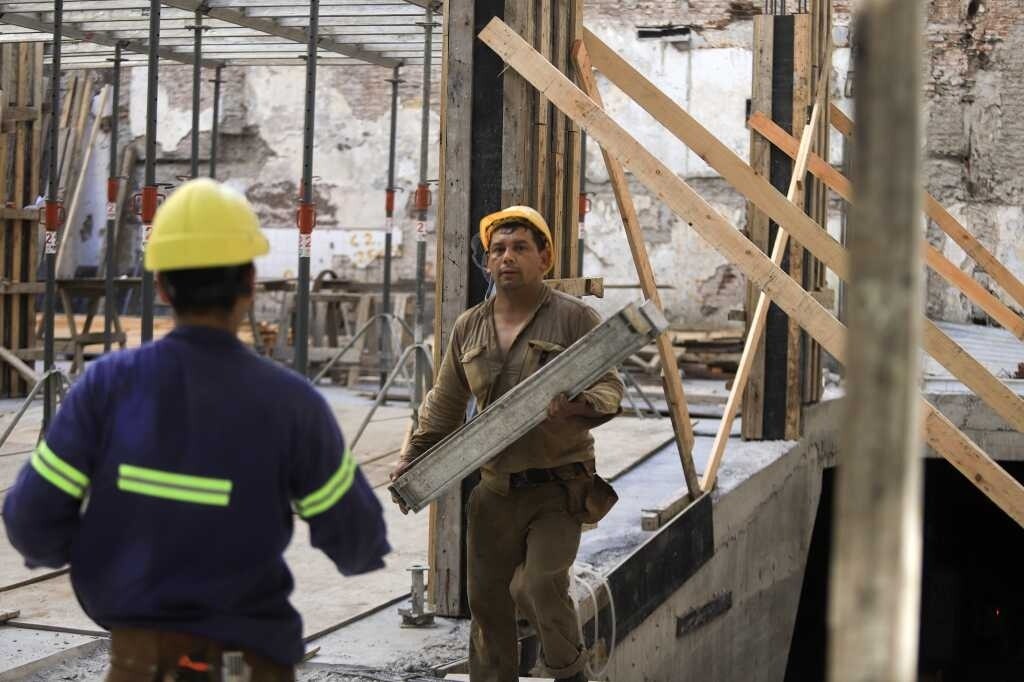
According to the report, the industrial share of the economy fell from 16.5% in 2023 to 13.7% in 2025, a level similar to what Argentina had before World War II, more than 80 years ago. The survey also indicates that 22 of the 24 industrial sectors recorded declines in their value-added between mid-2023 and mid-2025, reflecting a widespread crisis within the productive structure. The economy grew, but industry fell sharply. Fewer jobs in the last two years. Between the third quarter of 2023 and the same period of 2025, the Argentine economy grew by only 1.3%, while industry recorded a fall of 8.3%. The report also identifies other sectors that suffered setbacks: Construction: -14.1% Fishing: -24.6% Commerce: -5.2%. In contrast, some activities showed strong growth: Financial sector: +25.2% Mining: +17.9% Agro: +14.1%. Fewer jobs: the data that worries everyone. Industry in crisis in the 'Milei era'. Photo: Agencia NA (Cocot). Another critical indicator is the level of factory utilization. Since November 2023, around 100,000 jobs have been lost, equivalent to about 160 fewer jobs per day in the sector. Which sectors have been hit the hardest. Among the industrial branches that recorded the largest declines—between 20% and 25%—are: metallurgy, footwear, tanneries, industries linked to construction. Meanwhile, some sectors showed greater resistance, although also recording minor setbacks, such as the food industry, the tobacco industry, and the transport industry. Fewer industrial exports and more commodities. The study also detects a process of export simplification. During 2024 and 2025, the use of installed industrial capacity was below 60%, implying more than 40% of idle capacity. In parallel, the report warns of a strong destruction of industrial jobs. Industrial exports with higher value-added—known as MOI—fell to 28% of the total exported by the industry, when in 2011 they had reached a historical peak of 35%. This means that the sector's export basket is increasingly concentrated in food and commodities, with less technological content and less job generation. According to the report, the industrial sector also faces a cut in state support. Between May and October 2025, these imported machines multiplied by eight compared to the same period in 2024. The authors of the report warn that this trend could affect the performance of the national complex of agricultural machinery manufacturers. A setback of four decades. Finally, the study concludes that the industrial GDP per capita has sharply deteriorated: the current level is similar to that of 1985, which implies a setback of approximately 40 years in terms of industrial production per inhabitant. Researchers warn that these indicators reflect a process of deindustrialization that, if deepened, could have structural impacts on employment, production, and the export profile of the Argentine economy. Between 2023 and 2025, local production fell by almost 25%, while imports grew by 77%. To this is added the impact of Decree 273/2025, which liberalized the import of used agricultural machinery. Buenos Aires, March 8 (NA)– A report from the Faculty of Economic Sciences of the UBA warned about 'alarming symptoms' of crisis in the Argentine industrial sector, with a drop in production, loss of employment, and a smaller weight of the sector in the economy. The document, accessed by the Argentine News Agency, was prepared by the Area of Studies on the Argentine and Latin American Industry (AESIAL) and the Center for Studies on Argentine and Latin American Economic History (CEHEAL), and analyzes the evolution of the sector between 2023 and 2025. The data that worries industry. Photo: Agencia NA / Archive. One of the most important data in the report is the significant reduction in the weight of industry within the Gross Domestic Product (GDP). In the 2026 Budget, resources and exemptions destined for industry registered a reduction of 40%. The researchers point out that public support was concentrated mainly in the Regime of Incentive for Large Investments (RIGI), oriented to large foreign capital projects linked to energy, mining, and steelmaking. State of alert. The document also warns about the situation of the capital goods sector, considered strategic for industrial development.